


 english
 français
 Deutsch
 Italiano
 Русский
 Español
 português
 Nederlandse
 ελληνικά
 日本語
 한국
 العربية
 हिन्दी
 Türkçe
 indonesia
 tiếng Việt
 ไทย
 বাংলা
 فارسی
 polski

HWASHI · Resistance Welding Automation
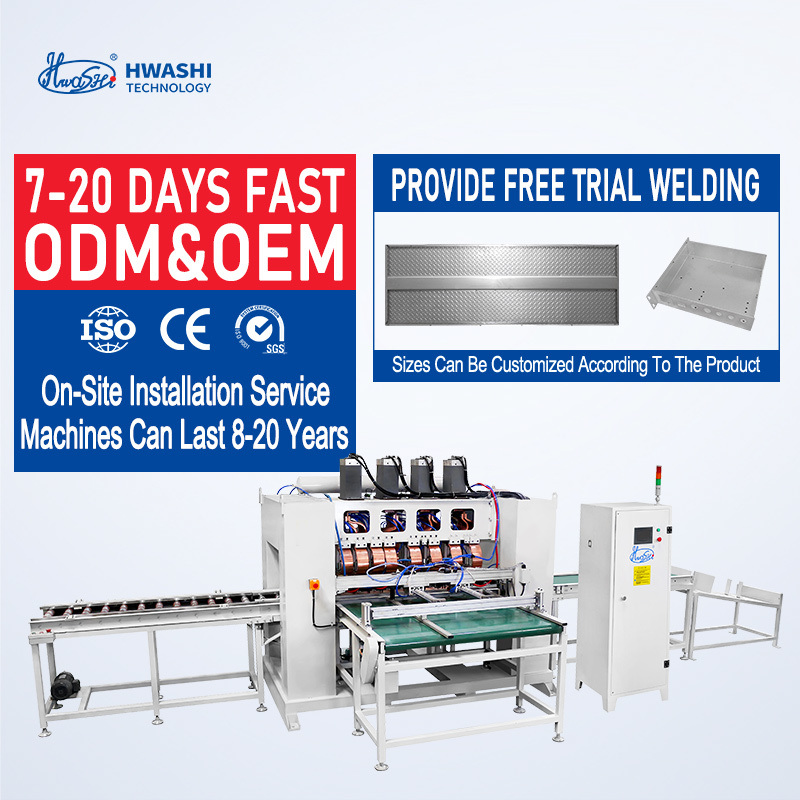
PLC-Controlled Multi-Head Spot Welding Machine for Door Panels
A configurable multi-head resistance spot welding platform for door-panel and sheet-metal assemblies. The published description supports simultaneous or sequential head operation and a stated welding capacity of up to 3+3 mm.
01 / Application overview
Multi-point welding for sheet-metal door assemblies
The machine is described for door-panel and sheet-metal production. Operators position the workpiece, start an automatic line of spot welds, then manually re-index the panel for subsequent welding lines. Multiple heads can be configured for simultaneous or sequential operation.
02 / Technical specifications
Published product parameters
| Parameter | Published value | Engineering / purchasing note |
|---|---|---|
| Model reference | WL-SQ100K | Confirm final model code on the quotation and machine nameplate. |
| Input supply | 380 V, 2-phase (attributes) | Voltage/phase differs from the reference table; verify site connection requirements. |
| Rated capacity | 150 kVA × 4 | Confirm meaning of the four-unit rating and total electrical load. |
| Maximum welding thickness | 3+3 mm | Validate using actual material grade, coating and stack-up. |
| System controller | U.S. MCC SCR | Controller/SCR designation as stated; confirm exact component make and model. |
| Control method | PLC | Programmable control and welding-condition setting. |
| Effective welding width | 1,000–2,000 mm | Final working envelope depends on approved part layout. |
| Effective welding length | 300 mm, customizable | Confirm usable fixture length and indexing method. |
| Material thickness range | 0.4–1.5 mm | Overview value; reconcile with separate 3+3 mm capacity claim. |
| Electrode force | 2.2 kN (reference table) | Verify applicability to the ordered configuration. |
| Welding schedules | 32 kinds (reference table) | Confirm available programs and parameter access. |
| Electrode spacing | 100–300 mm | Adjustable to the approved spot layout. |
| Warranty | 1 year for core components | Obtain written scope, exclusions and service terms. |
Reference model series shown on the product page
| Parameter | WL-SF-MF160K | WL-SF-MF120K | WL-SF-MF100K |
|---|---|---|---|
| Input voltage | 380 V, 3-phase | 380 V, 3-phase | 380 V, 3-phase |
| Input power | 160 kVA | 120 kVA | 100 kVA |
| Maximum welding current | 32,000 A | 30,000 A | 28,000 A |
| Maximum electrode force | 2.2 kN | 2.2 kN | 2.2 kN |
| Welding capacity | 3+3 mm | 2+2 mm | 1+1 mm |
| Welding heads | 10–20, according to customer drawings | ||
| Platform size | 2,000 × 300 mm, customizable | ||
These three columns are presented as a reference series from the listing, not as interchangeable configurations for WL-SQ100K.
03 / Operating sequence
Manual loading with automatic spot-welding cycles
- Position the workpiece. Load the door panel onto the worktable and locate it against the agreed fixture references.
- Start the programmed cycle. Activate the start control to initiate one line of spot welds.
- Complete the head sequence. Configured heads weld simultaneously or sequentially according to the approved program.
- Reposition the panel. Manually index the workpiece to the next welding line while maintaining datum references.
- Repeat and inspect. Continue the cycle and check weld locations and sample joints against the agreed quality plan.
04 / Configuration and engineering
Adaptable head arrangement for different panel layouts
Head spacing can be arranged to suit the customer’s spot layout, with adjustment described through the cylinder-bolt arrangement.
The touch-panel interface supports welding-condition setup and programmable parameter storage.
Automatic pressurization is described to reduce the need for operators to hold the workpiece during welding.
Working dimensions and head count can be tailored according to customer drawings.
Information to finalize before manufacture
- Part drawings with material grade, thickness and surface coating.
- Spot-weld map showing quantity, pitch, edge distance and location tolerances.
- Required cycle time, loading method and target output per shift.
- Plant power supply, grounding and required utility connections.
- Fixture datums, electrode access, part variation and changeover needs.
05 / Quality and acceptance
Build acceptance around the actual weld application
For production release, define the inspection method and acceptance limits before machine sign-off. A buyer-led validation plan may include first-off dimensional checks, weld-location verification, destructive peel or chisel tests on representative samples, and repeatability checks under agreed production conditions.
| Control point | Acceptance evidence to agree |
|---|---|
| Material and stack-up | Approved material specification, thickness records and sample-part confirmation. |
| Weld location | Spot map, fixture datum verification and measurement report. |
| Weld integrity | Agreed destructive test method and acceptance criteria. |
| Repeatability | Trial-run records across agreed part variants and operating sequences. |
| Machine safety | Electrical, guarding, emergency-stop and operator-instruction checks. |
This is a suggested procurement validation framework, not a claim that test reports or measured weld results are included as standard supply.
06 / Commercial and delivery terms
Published order information
| Item | Published term |
|---|---|
| Minimum order quantity | 1 set |
| Listed price | US$15,000 |
| Packaging | Seaworthy wooden package |
| Delivery time | 7–30 working days after payment received |
| Payment terms | T/T, L/C |
| Supply ability | 50 sets per month |
Confirm final price, configuration, Incoterm, packing dimensions, delivery milestones and shipment schedule in the signed quotation and contract.
07 / Manufacturer profile
Guangdong Hwashi Technology Inc.
Hwashi describes its business as the development and manufacture of resistance-welding automation equipment and industrial robots, with applications in home appliances, cookware, metal hardware, electronics and automotive components.
Certification scope
The manufacturer’s quality-control page lists a CE certificate for resistance welding machines (No. AT58250SC100084, issued 8 April 2021), alongside separate certificates for an IBC cage line, robot, sink grinding machine, and wire bending/cutting machine. Each certificate has its own stated equipment scope. Verify the certificate copy, validity and model coverage for the exact WL-SQ100K configuration before purchase.
08 / Company-level shipment evidence
Publicly indexed cross-border shipment activity
A public U.S. customs-data profile under the supplier-name variant “Guangdonghwashi Technology Inc.” shows 15 recorded shipments, 10 trading partners and five U.S. port locations for the displayed period from November 2006 to November 2026. The sample includes industrial machinery and welding-related equipment.
| Sample period | Consolidated product category | Importer / market example | Shipment profile |
|---|---|---|---|
| 2006–2026 | Industrial machinery and equipment | United States; multiple importer partners | 15 shipments, 10 partners, five port locations |
| 27 Jun 2024 | Six-head automatic wire mesh welding machine | American Appliance Products | 3,740 kg; 4 packages |
| 28 Jul 2024 | Welding robot / automatic pipe-bending machinery | KLYK LLC | 4,080 kg; 6 packages |
| 11 Dec 2025 | Pneumatic AC pulse spot-welding machine | Deerfield Farming Company Ltd | 517 kg; 1 package |
| 31 Oct 2026 | Leakage testing machine | Core Plastech International Inc. | 1,180 kg; 4 packages |
09 / Buyer FAQ
Procurement and application questions
Can the machine be configured for a specific door-panel drawing?
The listing describes customizable platform dimensions, adjustable head spacing and 10–20 heads according to customer drawings. Submit part drawings, spot map, material stack-up and target output for layout review before order confirmation.
Does the 3+3 mm capacity apply to every material combination?
No universal material combination should be inferred from the thickness headline. Performance depends on material grade, coating, stack-up, electrode geometry, force and weld schedule. Validate the actual combination through sample welding.
What is the difference between simultaneous and sequential head operation?
Simultaneous operation triggers configured heads in a coordinated cycle; sequential operation triggers heads or groups in a programmed order. The appropriate mode depends on part geometry, available power and process requirements. Confirm the supported sequence in the final control specification.
What should be confirmed about the 380 V, 2-phase power description?
The attributes state 380 V, 2-phase, while the reference model table states 380 V, 3-phase. Obtain the electrical schematic and written confirmation of phase, frequency, rated input current, protective devices and grounding before shipment.
Which quality documents should a bulk buyer request?
Agree on approved drawings, electrical component list, inspection checklist, trial-run record, safety inspection and sample-weld validation report. Specify material certificates or third-party testing in the purchase contract when required.
How should the machine be protected for ocean freight?
The listing specifies seaworthy wooden packaging. Define moisture-barrier wrapping, desiccants where appropriate, corrosion protection, shock protection, lifting points, center-of-gravity marking and package dimensions in the shipping specification.
What is the stated lead time?
The listing states 7–30 working days after payment is received. Drawing approval, configuration freeze, component availability, manufacturing and inspection milestones can affect the agreed schedule. Record the delivery plan in the contract.
What after-sales and warranty coverage is stated?
The listing states a one-year warranty for core components. Confirm the start date, covered parts, exclusions, spare-parts arrangements, remote troubleshooting scope, response time and any on-site service charges in writing.
10 / Procurement checklist